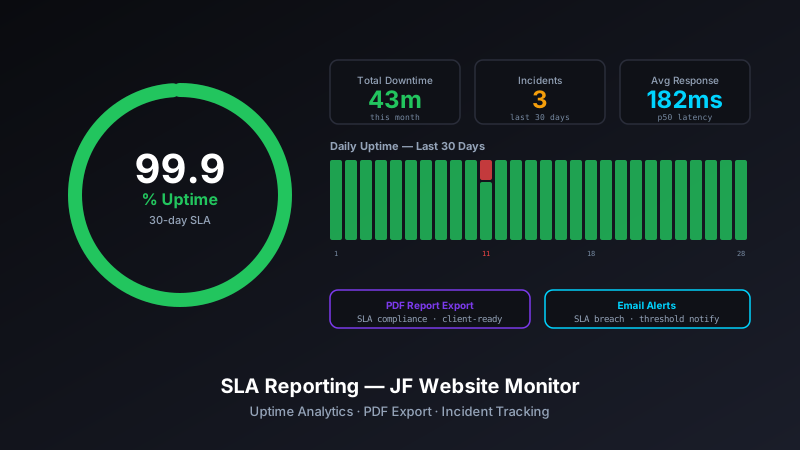
In today's digital landscape, maintaining service level agreements (SLAs) is critical for businesses that depend on online services. SLA reporting isn't just about proving uptime percentages—it's about demonstrating reliability, accountability, and transparency to clients and stakeholders. JF Website Monitor addresses these needs with comprehensive SLA reporting features that go beyond simple uptime tracking.
Understanding SLA Reporting Needs
Service level agreements typically require detailed reporting that includes:
- Accurate uptime percentages over specific time periods
- Response time measurements
- Incident timelines and resolution details
- Historical data for trend analysis
- Professional reports suitable for client presentations
Many organizations struggle with manual reporting processes or lack the granular data needed to meet SLA commitments. This is where automated monitoring tools with robust reporting capabilities become essential.
Comprehensive Uptime Reports
JF Website Monitor generates detailed uptime reports that provide more than just percentage statistics. The platform tracks:
- Uptime Percentages: Precise calculations of availability over customizable time ranges
- Response Times: Average, median, and peak response times for performance analysis
- Total Checks: Number of monitoring attempts to ensure data accuracy
- Incident Counts: Number of downtime events during the selected period
- Historical Trends: Long-term data visualization for identifying patterns
These metrics are presented in easy-to-understand visual charts that make compliance verification straightforward for both technical and non-technical stakeholders.
PDF Export for Compliance Documentation
One of the standout features for SLA compliance is the ability to export reports to PDF format. This functionality addresses several critical business needs:
- Compliance Auditing: PDF reports provide tamper-proof documentation for compliance requirements
- Client Reporting: Professional reports suitable for monthly or quarterly client reviews
- Legal Documentation: Formal records that can be used in contract disputes or SLA breach discussions
- Internal Tracking: Historical records for internal performance analysis
The PDF export feature ensures that organizations have the documentation they need for both internal and external reporting requirements.
Detailed Incident Tracking
When SLA breaches occur, detailed incident tracking becomes crucial for analysis and prevention. JF Website Monitor provides:
- Timeline Views: Chronological breakdown of all incidents during a selected period
- Duration Tracking: Exact duration of each downtime event
- Cause Analysis: Information about the reason for each incident when available
- Resolution Tracking: Time taken to restore service
- Impact Assessment: Understanding which services were affected
This level of detail enables organizations to conduct thorough post-incident analyses and implement preventive measures.
Visual Analytics for Easy Interpretation
Complex SLA data can be difficult to interpret without proper visualization. JF Website Monitor addresses this with:
- Uptime Charts: Visual representations of availability over time
- Performance Graphs: Response time trends and patterns
- Comparative Analytics: Side-by-side comparisons of different time periods
- Customizable Dashboards: Tailored views for different stakeholder needs
These visual elements make it easier for teams to quickly assess SLA compliance status and identify potential issues before they become problematic.
✅ Benefits of SLA Reporting
- Transparency: Clear visibility into service performance
- Accountability: Objective data for SLA compliance verification
- Proactive Management: Early identification of potential SLA risks
- Client Confidence: Professional reporting builds trust
- Regulatory Compliance: Meets documentation requirements
⚠️ Considerations
- Data Accuracy: Requires reliable monitoring infrastructure
- Time Investment: Initial setup and configuration required
- Storage Requirements: Historical data needs storage capacity
- Training: Teams need to understand how to interpret reports
Best Practices for SLA Reporting
To maximize the effectiveness of SLA reporting with JF Website Monitor:
- Define Clear Metrics: Establish which metrics are most important for your specific SLAs
- Set Realistic Targets: Ensure SLA targets are achievable based on historical performance
- Regular Reviews: Schedule periodic reviews of SLA performance with stakeholders
- Automated Alerts: Configure alerts to notify teams when SLA thresholds are approached
- Historical Analysis: Regularly analyze trends to identify improvement opportunities
Integration with Business Operations
Effective SLA reporting extends beyond technical monitoring to business operations. JF Website Monitor facilitates this integration by providing:
- Stakeholder Communication: Reports that non-technical stakeholders can understand
- Financial Impact Analysis: Correlation between downtime and potential revenue loss
- Vendor Management: Objective data for evaluating third-party service providers
- Continuous Improvement: Data-driven insights for service enhancement initiatives
Future of SLA Reporting
As businesses become increasingly dependent on digital services, SLA reporting will continue to evolve. Future developments may include:
- Predictive Analytics: Forecasting potential SLA breaches before they occur
- Automated Remediation: Systems that automatically respond to potential SLA violations
- Enhanced Visualization: More sophisticated dashboards and reporting interfaces
- Integration Capabilities: Seamless connection with business intelligence platforms
Conclusion
SLA reporting is a critical component of modern business operations, requiring both accurate data collection and professional presentation. JF Website Monitor addresses these needs with comprehensive uptime analytics, PDF export functionality, and detailed incident tracking.
By providing visual charts, historical data, and professional reporting capabilities, the platform enables organizations to maintain SLA compliance while building trust with clients and stakeholders. The combination of technical accuracy and business-ready reporting makes it a valuable tool for any organization serious about service reliability.
Whether you're managing client-facing services, internal applications, or third-party dependencies, comprehensive SLA reporting provides the transparency and accountability necessary for long-term success in today's competitive digital landscape.